
IPTV Reviews: How to Tell Evidence From Advertising
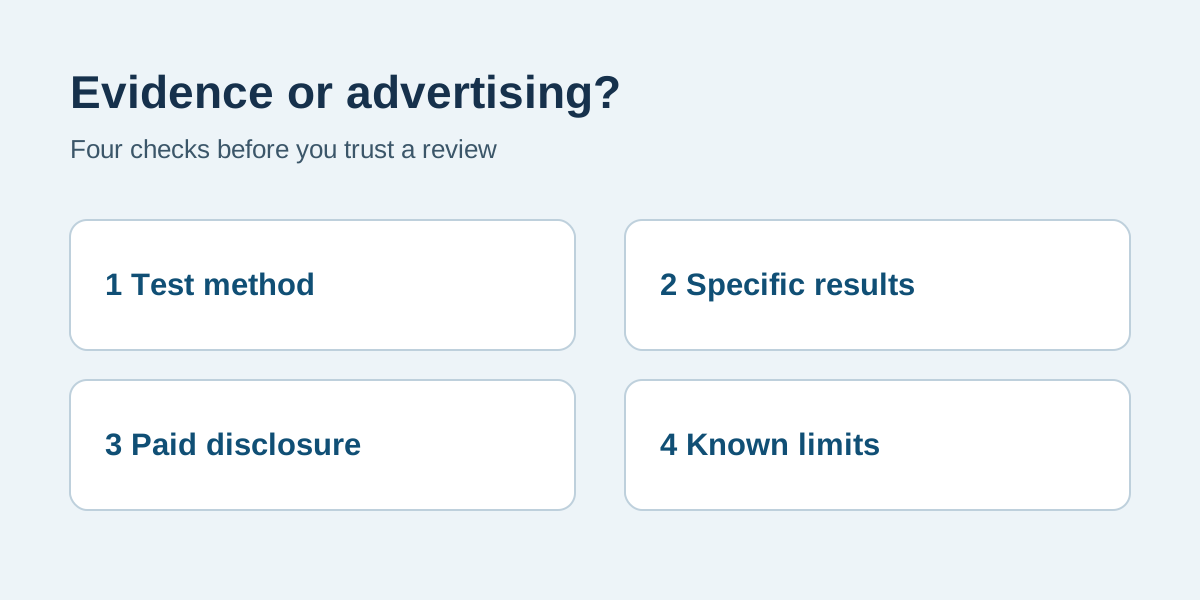
How can I tell whether an IPTV review is genuine?
Look for a dated and limited test method, the exact devices and conditions, results tied to specific claims, and a clear disclosure of any commercial relationship. An unsupported ranking alone is not test evidence.
A review can be useful without being perfect. The important question is whether you can tell what the writer observed, what the provider advertised, and what remains unknown. Use this checklist before treating a star rating or a “best IPTV” headline as a reason to buy.
Treat an unsupported superlative as advertising, not test evidence. Ask for the test method, a dated result, the limits of that result, and any commercial relationship. Then run a short trial on your own connection.
Start with the claim, not the score
Write down the precise claim you care about: “works on my Fire TV,” “two streams at once,” or “my local sports channel plays at 8 p.m.” A single overall score cannot answer all three. A review that shows channel counts but never mentions a device, time of day, or network condition gives you little evidence about your home setup. A shortlist is useful; a score without a method is not a measurement.
What a documented test should show
- The date and approximate length of the test, because lineups and performance can change.
- The device and player app used, including whether a separate app fee was involved.
- The network type and viewing time, especially a busy evening for live events.
- The exact tasks attempted: sign-in, channel switch, simultaneous streams, EPG and support contact.
- A result and a limitation for each task: for example, “the trial worked on one TV” does not prove a two-screen plan works.
Separate three different kinds of statements
“The provider advertises two connections” is a provider claim. “Two streams played together for 30 minutes on these devices” is a limited observation. “It will never buffer” is an unsupported promise. Good editorial work labels the first two and avoids the third. If a review uses a provider screenshot, it should say so; a marketing image is not a test log.
Look for a clear commercial disclosure
A commission link does not automatically make a guide wrong, but it can affect incentives. Look for a plain-language disclosure near the recommendation, not only in a distant footer. The US Federal Trade Commission explains that material relationships should be disclosed clearly and conspicuously. A review should also explain whether a provider supplied access, paid for placement or had editorial control. If that information is absent, do not assume independence.
Read what the review could not verify
A short trial cannot establish year-long uptime, every live event, or licensing rights to every channel. A reviewer should say what was outside the test rather than filling gaps with confidence. One working stream is not proof of a provider’s legal rights. If rights matter to you, ask the provider for specifics about the content and territory you intend to use.
Use a small comparison sheet
For each candidate, record the written plan price, renewal terms, connection limit, supported login format, device result, peak-hour result, support response and cancellation route. Keep the provider’s written terms or receipt. Comparing the same fields prevents one attractive claim from obscuring a missing answer. Do not commit to a long plan until the essentials have been tested or answered.
A five-minute example
Suppose a page says “best for families.” Find out whether that means several devices can install the app or several people can stream simultaneously. Ask the provider for its written connection rule. During a trial, play two different channels at once on the devices your household uses. Note the time and any error. If the review never tested concurrent playback, it should not be your evidence for a family plan.
How to use our site responsibly
Use our guides as questions to investigate, not as a substitute for checking a provider’s current terms. Provider pages and prices can change after publication. We may link to commercial services; any recommendation should be weighed against the evidence and limitations on the page. If we have not independently tested a claim, we should label it as a claim rather than presenting it as a verified result.
Continue your research
- BexyTV buyer guide — an example of checking claims before paying
- IPTV free trial guide — what to check on your own setup
Frequently asked questions
How can I tell whether an IPTV review is genuine?
Look for a dated and limited test method, the exact devices and conditions, results tied to specific claims, and a clear disclosure of any commercial relationship. An unsupported ranking alone is not test evidence.
Does an affiliate link make a review unreliable?
Not necessarily. The relationship should be plainly disclosed near the recommendation, and the review should still identify evidence, limitations and provider claims accurately.
What should I verify myself before paying?
Confirm the current price and renewal terms, device and player compatibility, concurrent-stream limit, the channels you need, support and cancellation route. Test on your own connection where a trial is available.
Learn more
- FTC Endorsement Guides FAQ — commercial disclosures in reviews
- Google Search Central — helpful, reliable, people-first content
See our top-rated IPTV services
Compare pricing, device support, trial options and the checks to run before choosing a service.
See the full ranking →