
How to Read IPTV Customer Complaints Before Buying
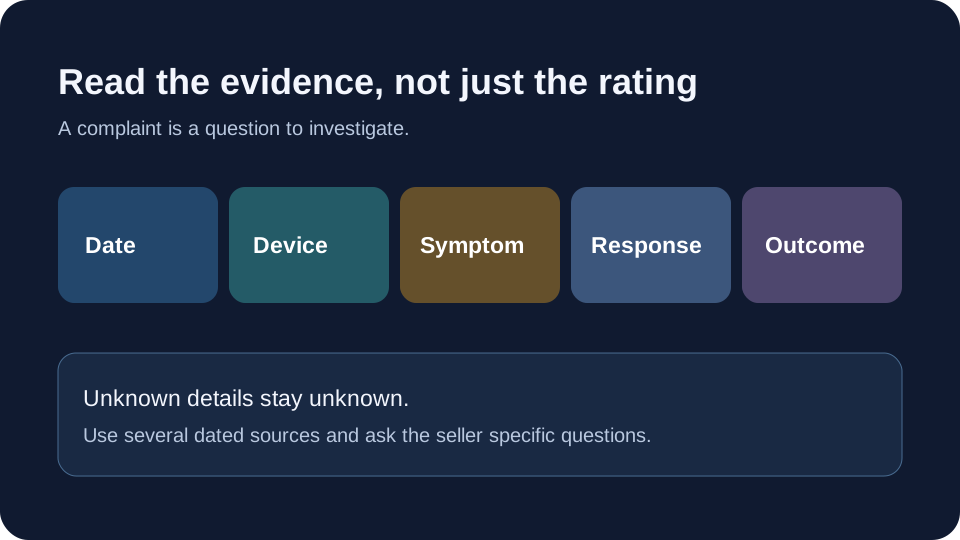
Do several IPTV complaints prove that a provider is unreliable?
No. They identify questions worth investigating, but public posts are not a representative sample. Compare dates, symptoms, independent sources and documented outcomes.
A complaint can warn you about a problem worth investigating, but one post cannot tell you how often it occurs for every customer. Before you choose an IPTV subscription, use complaints as questions to ask and evidence to check. This guide is an editorial method, not a claimed audit of any provider or an estimate of its failure rate.
Record what was reported, when, on which device and whether the provider replied. Compare independent, dated reports about the same issue. Keep unknowns visible rather than converting a handful of posts into a universal verdict.
Start with the precise symptom
“It does not work” is too broad to compare. Was the problem a failed login, an unavailable channel, a player crash, buffering, payment or cancellation? A complaint about one app version does not establish that the subscription is unusable on every device. Note the exact symptom and avoid silently changing it into a different claim.
Check timing and context
Record the publication date and, if given, the date of the incident. Ask whether the plan, device, player or region is identified. A complaint from several years ago may describe a setup no longer sold, while a current complaint may still be unresolved. Do not treat an edited review as proof of a current fix unless the writer explains what changed. The FTC recommends checking how recent reviews are and looking at more than one source.
Use a small complaint log
Leave any missing field blank. Never infer a customer identity, subscription tier or technical cause from a short public comment. Do not copy a customer password, order number or personal contact detail into your notes.
- Date of post and incident, if stated.
- Platform where the complaint appears and whether the account has other activity.
- Exact symptom, device, player and region actually stated.
- Provider answer or absence of an answer, with date.
- Reported outcome: resolved, unresolved or unknown.
- The question you will ask the provider before paying.
Look for patterns without inventing a rate
Several independent, recent reports describing the same exact symptom deserve a closer look. But public review sites do not provide a random sample of all customers, so a count of posts cannot be converted into an outage percentage. Also consider whether posts repeat the same wording or appear in a short burst. The FTC warns that deceptive reviews can be positive or negative and that appearance alone cannot reliably prove authenticity.
Read the provider response carefully
A useful reply names a next step or explains what information support needs. A generic “contact us” message may be a starting point, not a resolution. Record whether the original writer later confirmed a fix. Avoid treating silence as proof that the provider ignored the customer: some cases move to private support and the public thread may never be updated.
Separate playback from billing complaints
A login error and a cancellation dispute require different evidence. For playback, ask about supported devices, account limits and troubleshooting. For billing, save the written plan terms, renewal date, cancellation route and receipts. If a trial changes into a paid subscription, confirm the timing and conditions before submitting payment details. Do not assume that a smooth stream answers a billing concern.
Compare complaints with a trial of your own
If a provider offers a legitimate trial, test your actual device and usual viewing period within its stated terms. Keep a private log of the result. The trial can check your setup; it cannot prove future uptime or rights to every programme. Our streaming-quality worksheet explains how to record interruptions and sound or picture problems without claiming a test score for a provider.
A fictional example of careful reading
Imagine a review saying, “The channel froze last Friday on my older TV, and support sent new setup instructions Monday.” A fair note would say the writer reported one freeze on an unspecified player, received a reply after the weekend, and did not report whether the new instructions fixed it. That is neither a proof of constant failure nor a proof of a successful resolution. Ask the provider about support hours and your device before buying.
Turn the evidence into purchase questions
Ask the seller for the written connection limit, supported setup method, current pricing, renewal and cancellation terms, and support hours. Ask about the exact symptom that recurs in complaints. If the answer matters to your decision, keep a dated copy. A recommendation or commercial link is not a substitute for your own checks. This site promotes subscription services; weigh our links against the evidence and limitations on this page.
Continue your research
- Review evidence versus advertising — assess the source and disclosure
- Streaming quality test log — record a session on your own device
Frequently asked questions
Do several IPTV complaints prove that a provider is unreliable?
No. They identify questions worth investigating, but public posts are not a representative sample. Compare dates, symptoms, independent sources and documented outcomes.
What details should I record from an IPTV complaint?
Record the date, exact symptom, stated device and player, provider response, outcome and the question you need answered before purchase. Leave missing details blank.
Can I tell whether an IPTV review is fake by its wording?
Not reliably. Check the source, timing and other activity, but do not claim authenticity or fraud from appearance alone.
What should I ask before buying after reading complaints?
Ask about the repeated issue you found, supported devices, connection limits, support hours and written billing and cancellation terms.
Learn more
- FTC: How to Evaluate Online Reviews — source for review recency, multiple sources and deceptive review caveats
Check the plan before you subscribe
Commercial link: this site promotes subscription services. Confirm current plans, devices and setup information with the provider, then test the offer on your own equipment.
Visit TereaTV